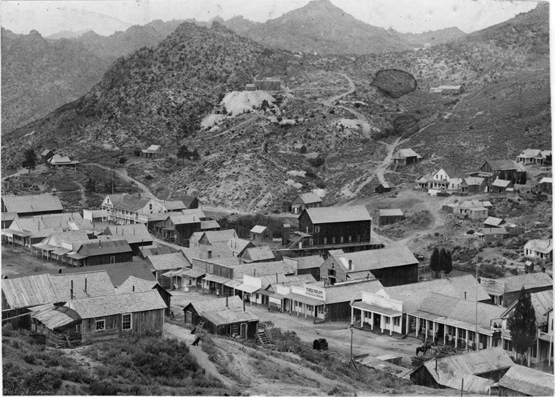
About seventy buildings still stand here, every one privately owned, and many of the owners are descended from the miners who put them up.
Silver City sits in northwestern Owyhee County, Idaho, and is listed on the National Register of Historic Places. It was founded in 1864, soon after silver was found at nearby War Eagle Mountain, 8,065 feet up, and grew quickly enough to be counted among the major cities of Idaho Territory. At its height in the 1880s it held around 2,500 people and roughly 75 businesses, and it served as county seat of Owyhee County from 1867 until 1934.
For a while it was the most modern place in the territory. The first daily newspaper and the first telegraph office in Idaho Territory were both established here, and the town was among the first places in present-day Idaho to get electric and telephone service. Together with Idaho City in the Boise Basin, the mining here accelerated Boise's growth as a staging and supply point.
The placer and quartz vein mines ran out around the time Idaho became a state in 1890. The decline was slow, helped along by how remote the place is, but it was never completely abandoned, and small-scale mining continued.
The people who live there put it plainly: Silver City is one of the few old mining towns that neither burned down nor got commercialised into a modern city, so visiting is close to walking into the past. The owners are frequently third or fourth generation descendants of the original miners. The land itself is federal, overseen by the Bureau of Land Management.
There are a handful of small businesses. The Idaho Hotel opens for the season and is much as it was a hundred years ago with a few modern amenities, and Pat's What Not Shop carries books, souvenirs and local mineral samples. There is no gas station and no service station, so arrive with a full tank.
Other places on the map within a couple of hours.
