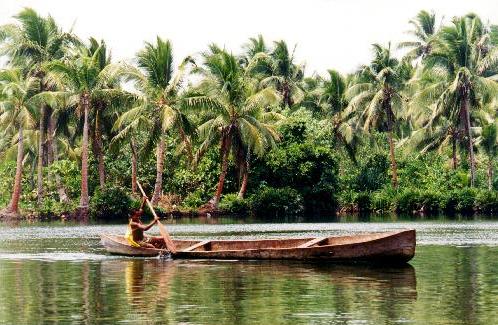
The world’s largest raised atoll, with a sea snake in a lake
Rennell is the southernmost of the Solomon Islands, 86 kilometres long and 15 wide, and it is the largest raised coral atoll in the world. At some point the whole ring of reef lifted clear of the sea. Its old lagoon became Lake Tegano, also written Te Nggano, which covers about 15,500 hectares and ranks as the largest lake in the insular Pacific. The lake surface still sits at sea level and the water is brackish, studded with rugged limestone islets and walled by cliffs. Dense forest covers the karst around it, the canopy averaging 20 metres high.
The southern third of the island, roughly 37,000 hectares plus a marine strip running three nautical miles offshore, was inscribed as the East Rennell World Heritage Site in 1998. It was the first natural site on the list held under customary ownership and management. The land, islands and reefs belong to the people who live there, a right recognised in the Solomon Islands constitution. Four villages stand around the lake, home to people of Polynesian origin who garden, hunt and fish for what they need. Estimates of their number run from about 800 to about 1,200.
Scientists value the island as a natural laboratory for island biogeography. Its bird list runs to 50 species, 21 of them endemic, among them the Rennell parrot, Rennell fantail and Rennell starling. There are 11 species of bat, one found only here, 27 land snails with seven endemics, and about 730 kinds of insect. More than 300 species of diatoms and algae make up the lake's flora. Crocker's sea snake lives in Lake Tegano and nowhere else on Earth. Rats and alien land snails, which have stripped the fauna of other Pacific islands, never got here.
The trouble lies just outside the boundary. Logging in West Rennell takes forest the endemic birds depend on, and the site's own forests are too small to carry those species alone. In 2013 the World Heritage Committee put East Rennell on its List of World Heritage in Danger. Rising water and salt in the lake, driven by sea level rise, have also cut harvests of taro and coconut in the low ground the villages farm. Frequent cyclones can be hard on the villages and the wildlife alike.
Rennell Island, Solomon Islands
See it on the map
This is remote ground. The closest other places on the map are a long way off.
