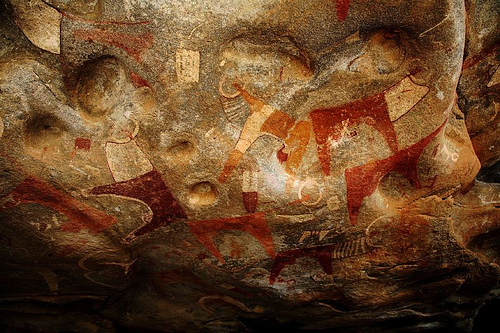
Five thousand year old paintings that look painted last year
Laas Geel is a granite outcrop on the road between Hargeisa and Berbera in Somaliland, rising from a plateau 950 metres above sea level where two seasonal rivers meet. The British Museum's rock art project treats that meeting of rivers as the key to why the paintings exist at all, and the name, the camel's well in Somali, still refers to the water lying close beneath the dry riverbeds.
People living nearby had known the paintings for centuries. The wider world heard of them in 2002, when a French team led by Xavier Gutherz, surveying the Horn of Africa for the beginnings of herding, recorded them, and a mission returned in November 2003 for a detailed study. Excavation in one shelter recovered pieces of the painted wall itself, and the team dated the art to between the mid-4th and mid-3rd millennia BC, roughly 5,500 to 4,500 years ago. That makes it the oldest known rock art in the region and among the oldest evidence of cattle domestication in the Horn, though the bovine bones from the dig were too poorly preserved to say whether the animals were domestic or wild.
The paintings run through about 20 rock shelters, the biggest around 10 metres long, in red, white, black, violet, brown and yellow, and the granite overhangs have kept them in excellent condition. Most show humpless cows with curved or lyre-shaped white horns and marked udders. Their necks are drawn as wide rectangles, blank or filled with red and white stripes, and are read as mats hung from the neck as a ceremonial ornament. Beside them stand human figures with arms stretched out to the sides, usually in a white shirt, heads sometimes ringed with a crown of dashes, some carrying a bow, a stick or a shield. Dogs appear near the people; antelopes, monkeys and two lone giraffes are much rarer, and geometric symbols surround many of the cows.
The work belongs to the Ethiopian-Arabian style, and at first its particular look had no parallel. Later finds at Dhambalin, Karin Hagane and Dhaga Koure share it, and researchers now speak of a distinct Laas Geel style.
Marodi Jeh, Somaliland
See it on the map
This is remote ground. The closest other places on the map are a long way off.
