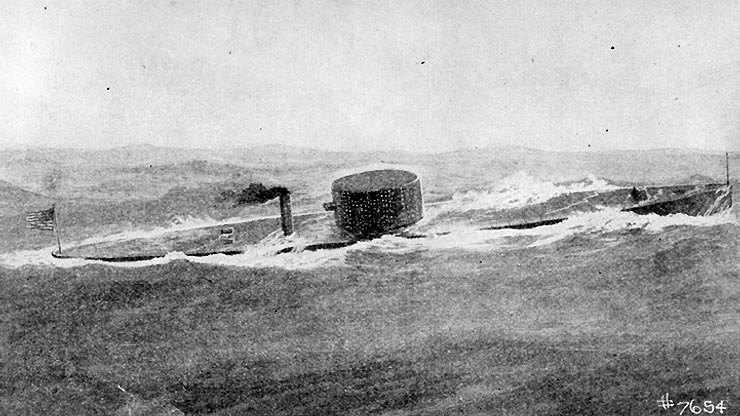
The ironclad that fought the Virginia to a draw, on the bottom off Hatteras
USS Monitor lies in 230 feet of water about 16 miles southeast of Cape Hatteras, North Carolina, the Union ironclad that changed naval warfare in a single afternoon.
She was built in a hurry. Northern newspapers were reporting daily that the Confederates had raised the scuttled steam frigate Merrimack at the Gosport navy yard near Norfolk and were plating her in iron as CSS Virginia, and in late February 1862 Mary Louvestre, a freed slave who kept house for one of the Confederate engineers, crossed the lines with a message hidden in her dress and told Navy Secretary Gideon Welles the ship was nearly finished. The Swedish-born engineer John Ericsson designed Monitor, around a revolving gun turret by the inventor Theodore Timby, and she was built in 101 days on the East River in Brooklyn.
She arrived at Hampton Roads a day late for the first of it. On 8 March Virginia had destroyed the sail frigates Cumberland and Congress and run the steam frigate Minnesota aground. Next morning, 9 March, as Virginia came back to finish Minnesota, Monitor under Lieutenant John L. Worden steamed out to meet her. For four hours the two ironclads pounded each other at close range, and neither could destroy or seriously damage the other. It was the first battle ever fought between armoured warships, and the turret design was soon copied into a whole class of American warships called monitors. Virginia was scuttled when the Confederates abandoned Norfolk that May.
On 31 December 1862, under tow by the steamship Rhode Island on her way to blockade duty off North Carolina, Monitor ran into a heavy storm off Cape Hatteras. After a frantic rescue effort she capsized and sank stern first, taking sixteen men with her, four of them officers, some still in the turret as it broke away.
A Duke University expedition with National Geographic and the National Science Foundation found her by towed sonar on 27 August 1973, almost 111 years later. To protect her from salvors, the wreck and the half nautical mile around it became the Monitor National Marine Sanctuary on 30 January 1975, the first marine sanctuary in the United States. Her 120-ton turret broke the surface on 5 August 2002, with a tropical storm bearing down on the recovery team. Inside were the bones of two sailors, never identified, who were buried at Arlington National Cemetery with full military honours on 8 March 2013. The turret, Dahlgren guns and steam engine, among more than 200 tons of recovered artefacts, are being conserved at the Mariners' Museum in Newport News, Virginia.
North Carolina
See it on the map
Other places on the map within a couple of hours.
