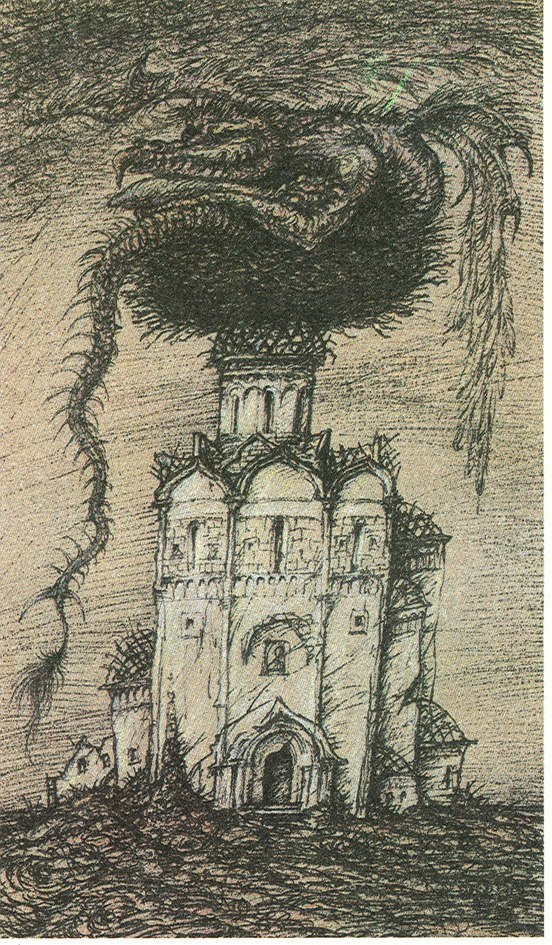
Old Slavic weather-dragon tradition, still on the map in place names
The Slavic dragon is not one animal, and Bulgarian tradition is unusually clear about the split. There is the zmey and there is the lamia, called the hala in some districts, and they are opposed to each other. In many tellings they are brother and sister, which makes the opposition sharper rather than softer.
The zmey is male and, broadly, he is on your side. In Bulgarian folk belief he protects the village fields and the harvest. He can appear as a young man, strong and handsome, with wings under his arms, and in a large body of song he falls in love with a village girl and takes her, which the tradition treats as a complicated blessing rather than a simple horror.
The lamia is female and she is never anything but dangerous. She arrives as storm and hail and destroys the crops. The descriptions are lurid: yellow scales, four legs, claws, a tail, a mouth that can take a whole man, and in the songs three heads, or seven, or nine. The zmey fights her, in the sky, over your ground.
Read as weather this is immediately sensible. A June hailstorm that flattens a wheat crop is the disaster of the Balkan agricultural year, and the tradition supplies a local defender who meets it. The zmey is not a distant deity; he belongs to a particular village and a particular stretch of land.
That is also what separates him from the Western dragon, which is essentially a hoarding predator to be killed by a knight. The Bulgarian zmey can be a neighbour, a protector and an ancestor.
The pin sits on the Stara Planina, the central Balkan range the songs come out of: high ridges, villages farming the valleys beneath them, and summer storms that arrive over the top with no warning at all.
The Balkan Mountains (Bulgaria)
See it on the map
Other places on the map within a couple of hours.
