The oldest wooden structure on Earth, 476,000 years old
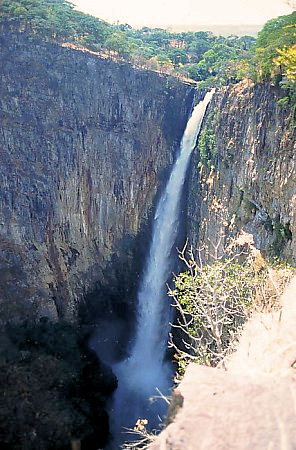
The Kalambo River drops 235 metres in a single fall on the border between Zambia and Tanzania's Rukwa Region, near the southeast end of Lake Tanganyika. It is the tallest waterfall in both countries and one of the tallest uninterrupted falls in Africa, and below it the Kalambo Gorge, about 1 km wide and up to 300 metres deep, runs for some 5 km before opening into the Lake Tanganyika rift valley. Its height has been argued over: it was first assumed to exceed 300 metres, measurements in the 1920s gave a little over 200, and a survey in 1956 gave 221.
Upstream of a narrow spillway gorge, around a small basin, lies one of the key Palaeolithic sequences of Africa. J. Desmond Clark discovered the site in 1953 and excavated it through the 1950s and 1960s, recovering waterlogged Acheulean living floors that preserved charred wood, seeds and what looked like wooden tools, in a sequence running from the late Acheulean to the late Iron Age. Later work found that the river itself had created much of the patterning, and may even have shaped some of the supposed tools, and without reliable dates the site slipped out of the debate. A team returned in 2006 to take samples for luminescence dating.
Excavations in 2019 brought the result. In waterlogged sediments below river level, dated by luminescence to at least 476,000 years ago, give or take 23,000, lay two interlocking logs joined crosswise by an intentionally cut notch. It is the earliest evidence for the structural use of wood in the archaeological record, with no known parallel in the African or Eurasian Palaeolithic, and possibly part of a platform beside what was then a water source. Higher in the sequence, from 390,000 to 324,000 years ago, came four wood tools: a wedge, a digging stick, a cut log and a notched branch. Wood rarely survives from the Early Stone Age; here a permanently elevated water table preserved it.
The structure predates Homo sapiens, and its makers may have been Homo heidelbergensis, a 300,000-year-old skull of which was found at another Zambian site. The finds show early hominins shaping tree trunks into large combined structures, and they push back the known history of woodworking in Africa. People have come back to Kalambo again and again ever since, with occupation spanning more than 447,000 years.
Northern Province, Zambia
See it on the map
Commons photos · Atlas Obscura · UNESCO tentative list · Protected Planet · Britannica · GeoNames · OpenStreetMap
This is remote ground. The closest other places on the map are a long way off.
