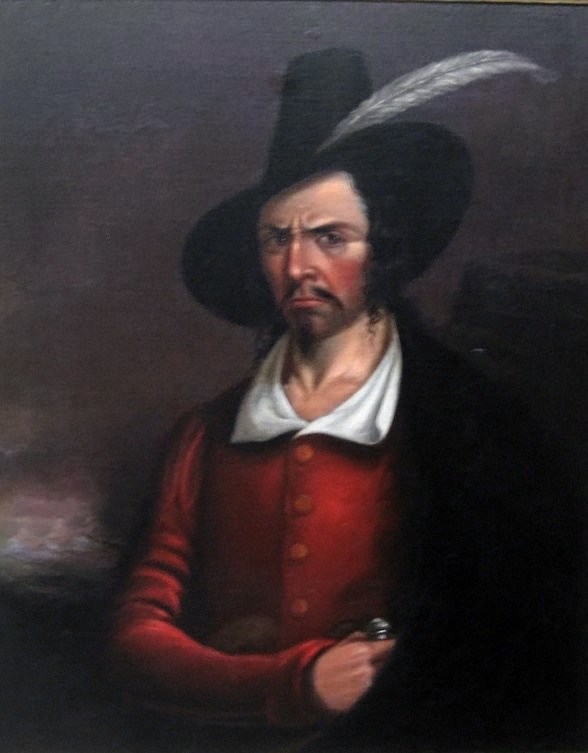
A real privateer fortune, and not one authenticated cache
Jean Lafitte's treasure is buried, according to legend, almost everywhere along the Gulf coast between New Orleans and Galveston, from the barrier islands of Barataria to Contraband Bayou at Lake Charles. The man behind it is nearly as elusive. Even the date and place of his birth are unknown, France or the French colony of Saint-Domingue, now Haiti, sometime around 1780. He and his older brother Pierre spelled the name Laffite; English documents of the day wrote it Lafitte, and the spelling stuck.
By 1810 the brothers were running the most successful smuggling business in Louisiana. The Embargo Act of 1807 had choked off imports, and from Grand Terre, a barrier island near Grand Isle on Barataria Bay, Lafitte's Baratarians, perhaps as many as 1,000 people, brought in goods duty-free through the swamps and bayous to buyers in New Orleans. Lafitte always insisted he was a smuggler and a privateer, sailing under letters of marque from rebel Cartagena, never a pirate; the United States charged him with piracy anyway. His trade also included human beings. After Congress banned the international slave trade in 1808, he trafficked enslaved people into south Louisiana, working the auction laws with Jim Bowie and his brothers.
In September 1814 a British captain landed on Grand Terre and offered Lafitte $30,000 and a captaincy to help attack New Orleans. Lafitte stalled, warned the Americans instead, and saw a US force raid his base and take most of his fleet anyway. He still brought his men, guns and knowledge of the waterways to Andrew Jackson, and after the victory at New Orleans in January 1815 the Baratarians were pardoned and praised in Jackson's dispatches.
Lafitte moved west. In 1817 he founded Campeche on Galveston Island, in Spanish Texas, while spying for Spain, and ran it as a new smuggling port from a moated, red-painted house called the Maison Rouge, earning millions of dollars a year from stolen and smuggled coin and goods. In 1821 the USS Enterprise came to remove him. He left without a fight on 7 May aboard The Pride, his men burned the Maison Rouge and the settlement behind him, and he is said to have taken immense treasure along. He probably died around 1823 and was buried at sea in the Gulf of Honduras, though rumours had him living on under another name.
The treasure hunters never stopped. In 1909 a man got six years in prison for swindling people out of thousands of dollars with a claim to know where the Lafitte treasure lay. Part of his old smuggling country is now the Barataria Preserve of Jean Lafitte National Historical Park and Preserve.
The Barataria coast and Galveston Island (LA and TX)
See it on the map
Other places on the map within a couple of hours.
